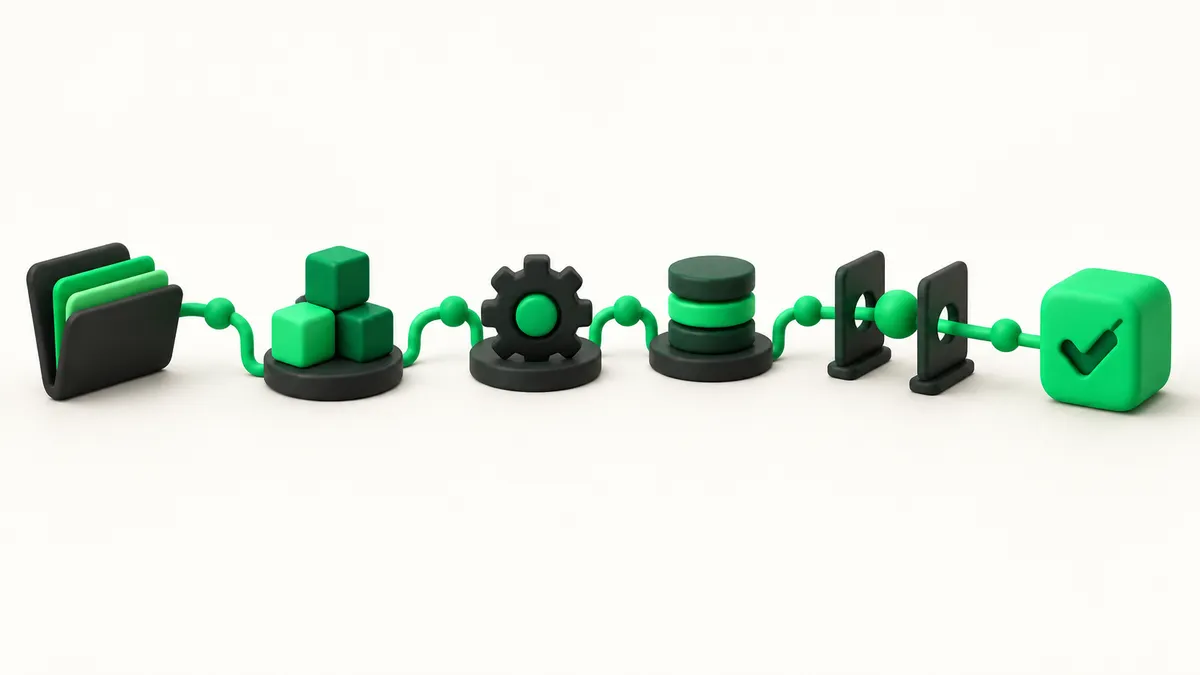
AI workers are software assigned an ongoing role and workflow, not just tools that answer one prompt. The useful test is what an AI worker can access, produce, decide and send to a person for approval.
- A role needs boundaries Define its objective, approved inputs, permitted tools, output and human handoff.
- Marketing work can be divided Separate planning, articles, SEO, images, social posts and reporting into specialist responsibilities.
- Keep approval human The owner or marketing lead approves and publishes, edits, or rejects work with an optional rewrite.
What makes an AI worker different from an AI tool?

An AI worker completes an ongoing, assigned responsibility through defined steps and tools. A chatbot usually responds to an individual request; a single-purpose automation follows a trigger-and-action rule; an AI worker carries a recurring workflow from inputs to a deliverable. The label matters less than the control points: what the software may access, what it may produce, what it may decide and when it must escalate to a person.
| Type | Work pattern | Typical output | Human role |
|---|---|---|---|
| Chatbot | One exchange at a time | An answer | Person directs each request |
| Automation | Preset trigger and action | A completed action | Person sets or checks the rule |
| AI worker | An assigned responsibility over time | An ongoing deliverable | Person reviews and approves |
| Human-led work | A person leads the decisions | Approved marketing work | Software assists where permitted |
What five parts does an AI worker need?
An AI worker can prepare repeatable work, but business goals, sensitive claims, brand judgement, exceptions and final approval should remain named human responsibilities. A failed check should not silently become published work.
A workable AI worker needs five explicit parts: an objective, approved inputs, permitted tools, a defined output and a human handoff. “Handle our marketing” leaves too much undecided; “draft one article from this approved brief, apply these brand rules and wait for approval” gives the role a checkable boundary.
| Objective | Inputs | Tools | Output | Human handoff |
|---|---|---|---|---|
| Draft an SEO article | Approved brief and business facts | Writing and SEO tools | Article with metadata | Owner approves, edits or rejects with an optional rewrite |
| Prepare social posts | Approved topic, offer and brand rules | Social drafting tools | Posts ready for review | Owner approves, edits or rejects with an optional rewrite |
| Measure published work | Your publication and analytics data | Reporting tools | Traffic and ranking report | Marketing lead interprets the result |
How can AI workers handle a marketing week?
An AI marketing team can turn a brief into a weekly content plan and divide it among specialist roles. Vibrant Media describes work covering SEO blog articles, on-brand images, social media posts, article meta titles and descriptions, traffic and ranking reports, business listings and backlink building.
A chief manager coordinates the weekly plan; specialist roles produce particular deliverables; automatic checks run before the owner sees the work for approval. Vibrant Media says those checks cover facts, brand rules, policy, originality against the project’s published archive, SEO and machine readability.
The owner’s control remains practical rather than ceremonial: approve and publish the draft, edit it, or reject it with an optional rewrite. Vibrant Media also states that a draft failing a check is held for the owner’s review.

How should you pilot an AI worker?
Pilot one repeatable workflow before assigning an AI worker a broad marketing brief. Choose work with stable inputs, a clear definition of done and an approval point that a person can realistically review.
A controlled pilot sequence
- Limit the role to the tools and information required for that job.The worker should not need unrestricted access to unrelated business systems.
- Test representative cases, including incomplete briefs and sensitive claims.Record where the output needs correction, not only where it looks polished.
- Review failures and tighten the instructions, checks or escalation path.A repeated failure shows that the role boundary or input is not ready.
- Expand only after the approval queue and correction effort remain manageable.Measure usable completed work, review burden and business outcomes rather than activity alone.
Signs the setup is working
Can you trace each output to its brief and approved source material?
If not, the workflow needs better input records before you add more volume.
Are the checks visible before approval?
A useful setup shows which checks ran and leaves the owner able to approve, edit or reject the work.
Does reporting use your own publication and analytics data?
Vibrant Media describes saved publication evidence alongside traffic and ranking reporting; whatever system you use, connect measurement to your own data rather than activity counts alone.
What terms should you understand before choosing AI workers?
An AI worker is a software role with an ongoing responsibility; a workflow is the sequence connecting inputs, actions, checks and handoff; a guardrail is a permission limit or review rule; and an approval queue is the set of outputs waiting for a person’s decision. These terms describe operating controls, not proof that a system can make business decisions safely on its own.
AI worker terms
- Input
- The approved brief, facts, rules or data an AI worker may use.
- Output
- The defined deliverable, such as an article, social post or report.
- Guardrail
- A permission limit, quality check or escalation rule.
- Human handoff
- The point where a person reviews, edits, approves or rejects work.
Vibrant Media is a subscription AI marketing team that creates, publishes and measures content for businesses, offering ai marketing, content marketing and small business marketing. vibrantmedia.com