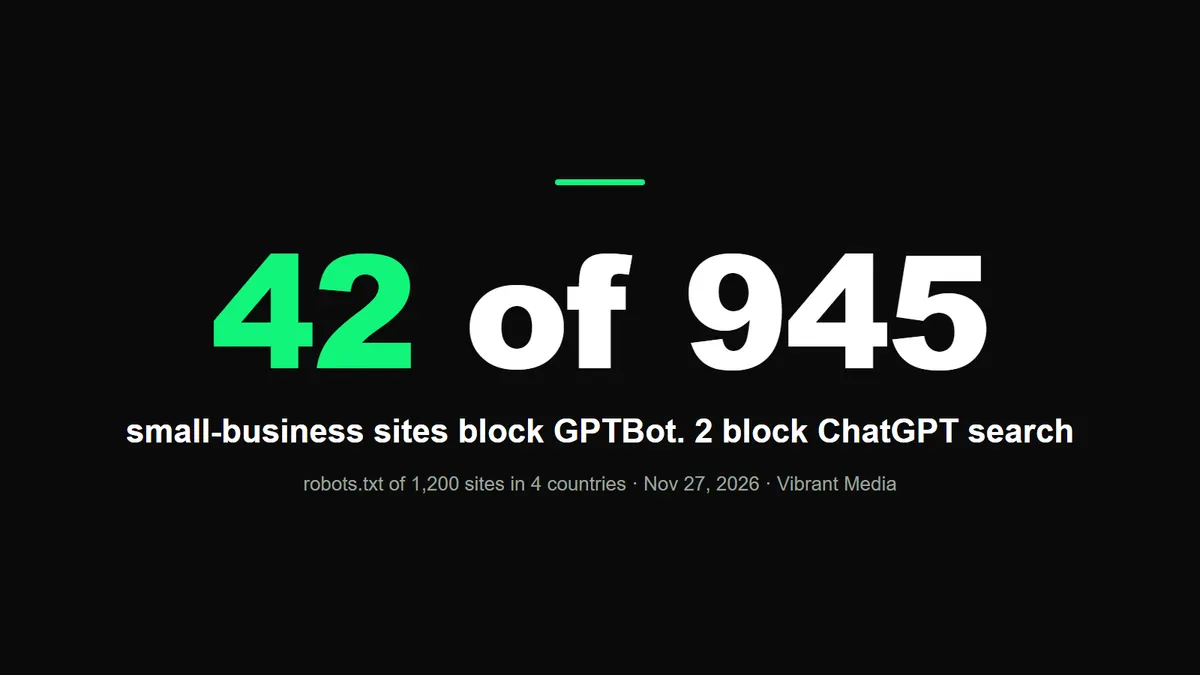
A warning keeps going around: block GPTBot carelessly and you can drop out of ChatGPT search too, because OpenAI uses a separate crawler for search and people mix the two up. We wanted to know how often that has happened on small-business sites. So we ran our robots.txt checker over 1,200 of them and counted.
It has barely happened. Two sites in 945 close ChatGPT search, and neither file mentions ChatGPT anywhere. The number that surprised us was a different one. On most small sites that block GPTBot, Cloudflare wrote the rule after somebody flipped one switch.
The short version
- We drew 1,200 sites of shops, restaurants and service firms from OpenStreetMap in the United States, Canada, the United Kingdom and Australia. 953 gave a usable answer: 862 have a robots.txt and 91 have none. 8 of them close the whole site to Google, so the counts below are out of the other 945.
- 42 of 945 (4.4%) close the site to GPTBot, the crawler OpenAI uses to collect training data. Among the 854 that have a file at all, that is 4.9%.
- In 31 of those 42 the only thing closing GPTBot is a section that Cloudflare adds to the file when its managed robots.txt setting is on. One more file is a Cloudflare-made list in another format, and one comes from a Squarespace checkbox. Seven files name GPTBot in a rule with no platform's signature on it. Two close it with a catch-all rule.
- 2 of 945 close OAI-SearchBot, the crawler behind ChatGPT search. Both files are allowlists that let in Google and a few others and shut out every crawler they do not name. No site in the sample closes OAI-SearchBot by name.
- 40 of the 42 sites that block GPTBot are still open to ChatGPT search.
What we measured
The sites come from OpenStreetMap. We took places tagged with a website in 20 large cities, five each in the four countries. The places are shops, restaurants and cafes, dentists, vets, lawyers, accountants, estate agents, architects, insurance offices and craft businesses such as breweries and plumbers. Places tagged as a brand were left out.
To keep chains and directory pages out, a site had to pass three rules. It appears at exactly one place in the whole pull. The listed address is the home page, with no path after the domain. And it sits on its own domain, with no subdomain. From what was left we drew 100 sites for each country in each of three groups (shops, food, services), in an order fixed by a random seed. OpenStreetMap tags hairdressers and beauty salons as shops, so they are in the shop group.
Each site went through the same code that answers on the checker page. It asks for robots.txt once, waits up to five seconds, and reports for 17 crawlers whether the file lets them in and which rule decided it. We count a site as closed to a crawler when the file closes both the home page and a deeper page to it. Sites that did not answer were tried again at least twice.
247 of the 1,200 are not in the counts. 126 could not be reached: the connection timed out, the certificate was broken or the server returned an error. 47 redirect to a different domain, which usually means the business moved or closed. 74 answered with something that is not a robots.txt: 41 refused the request with a 403, 17 sent a web page, 13 sent an empty reply and 3 sent something else. Everything here is one snapshot, taken on November 27, 2026. One script prints the counts from a data file stored next to it (scripts/robots-study.mts in our repository), so running it again gives the same output.
Who blocks GPTBot, and who wrote the rule
| Crawler | Closed on, of 945 | What it is for |
|---|---|---|
| GPTBot | 42 | OpenAI, collects pages that may be used for training |
| ClaudeBot | 42 | Anthropic, collects pages that may be used for training |
| CCBot | 42 | Common Crawl, builds an open web archive |
| Google-Extended | 40 | Google, the switch for Gemini training and grounding |
| Applebot-Extended | 40 | Apple, the switch for model training |
| meta-externalagent | 39 | Meta, crawls to train its models |
| Amazonbot | 38 | Amazon, may be used for training |
| ChatGPT-User | 3 | OpenAI, opens a page when a ChatGPT user asks for it |
| OAI-SearchBot | 2 | OpenAI, finds pages for ChatGPT search |
| Claude-SearchBot | 2 | Anthropic, search in Claude |
| PerplexityBot | 2 | Perplexity, finds pages for its results |
| Claude-User | 2 | Anthropic, opens a page a user asked about |
| Perplexity-User | 2 | Perplexity, opens a page a user asked about |
| meta-externalfetcher | 2 | Meta, opens a link a user asked about |
| Applebot | 0 | Apple, search for Siri and Spotlight |
| Bingbot | 0 | Microsoft, Bing search |
The training crawlers move together because one block lists them all. When a site owner turns on Cloudflare's managed robots.txt, Cloudflare puts a section of its own at the top of the file. In the files we collected that section carries the heading "Training crawlers" and a Disallow: / for GPTBot, ClaudeBot, CCBot, Google-Extended, Applebot-Extended, Amazonbot, meta-externalagent and a couple of dozen more. Cloudflare's documentation says it "will prepend our managed robots.txt before your existing robots.txt", and the company wrote last year that customers had turned the feature on "for over 3.8 million domains".
We tested each of the 42 files a second way. We cut the Cloudflare section out and ran the check again. In 31 files GPTBot was no longer closed, so that section is the only thing closing it.
That leaves eleven. One file is headed "Cloudflare crawl control rules" and is a Cloudflare-made list in a different format. One is a Squarespace file with the AI checkbox ticked. Two never name GPTBot and close it with a catch-all. Seven name GPTBot in a rule that carries no platform's signature, and at least two of those say what they mean in plain words. One opens with the comment "Search engines and AI search / answer assistants are welcome. Crawlers that collect content to train AI models are blocked."
Do the other owners know? The file cannot say. Somebody did turn the Cloudflare setting on. But flipping a switch in a dashboard and typing a line are different amounts of attention, and our guess is that many of those 31 owners could not list the crawlers their site now turns away. Google-Extended is on that list, and it is the name Google reads to decide whether your pages may be used for Gemini. That is a guess, not a measurement.
ChatGPT search is almost never closed
OpenAI runs separate crawlers and treats them separately. Its documentation says GPTBot "is used to crawl content that may be used in training our generative AI foundation models", while OAI-SearchBot "is used to surface websites in search results in ChatGPT's search features". It adds that "each setting is independent of the others". A site that closes only GPTBot stays in ChatGPT search. A site that closes OAI-SearchBot "will not be shown in ChatGPT search answers, though can still appear as navigational links".
Two sites in 945 close OAI-SearchBot. One has a hand-written file that names Googlebot, Bingbot, DuckDuckBot and three more crawlers as welcome and ends with Disallow: / for everyone else. The other is a photographer's site hosted on SmugMug, and the platform's file works the same way: a list of crawlers that may come in, and a closed door for the rest. Neither file contains the word OAI-SearchBot. An allowlist closes the door on every crawler launched after the list was written, and nobody has to decide anything for that to happen.
Those two files also close GPTBot, ClaudeBot and the other crawlers they do not name. That is where the 2s in the lower half of the table come from.
The other 40 sites that close GPTBot leave OAI-SearchBot alone. So of the sites that block GPTBot, nearly all are closed to training and open to search, and mostly that is because Cloudflare's section is built that way.
What the platforms do
Many small sites run on a platform that writes robots.txt for them. We sorted the 945 sites by the signature each platform leaves in the file.
| Signature in the file | Sites | Close GPTBot |
|---|---|---|
| Shopify | 94 | 0 |
| Squarespace | 114 | 1 |
| WordPress paths | 221 | 5 |
| None of these, or no file | 516 | 36 |
Squarespace is the one that fools the eye. Its standard file names GPTBot, ClaudeBot and two dozen other AI crawlers, which looks like a block. It is not one. The names share a group with the catch-all rule, so those crawlers get the same rules as everybody else. They are closed only when the owner ticks "Block known artificial intelligence crawlers", and Squarespace says "we default to having the box unchecked". One site of the 114 had ticked it.
The Cloudflare section sits on top of whatever the platform wrote. Four of the five WordPress sites in the table are closed to GPTBot by that section and nothing else.
By country, GPTBot is closed on 13 of 229 sites in the United States, 13 of 248 in Canada, 12 of 231 in Australia and 4 of 237 in the United Kingdom. By group it is 19 of 324 service firms, 14 of 319 shops and 9 of 302 restaurants and cafes. With counts this small we would not read much into the gaps.
Two things that cost more than any AI rule
8 of the 953 sites that answered close the whole site to Google. Five of the eight carry the Squarespace signature, one carries Shopify's and two carry none. Our guess is unpublished sites, password pages and expired plans, but the file does not say. Whatever the reason, a file like that hides the site from Google, Bing and every AI crawler at once.
And 41 sites answered our request for robots.txt with a 403. The request was refused before any file was read, usually with a web page where the file should be. That is what a firewall or a bot filter does, though a 403 alone does not prove one. We cannot say what those sites do to GPTBot or OAI-SearchBot. The robots.txt cannot say either, because the decision is made somewhere else.
How this compares with big sites
Chris Humphrey read the robots.txt files of the top 10,000 sites in June 2026. Of the 7,870 that gave him a usable answer, 17.6% blocked GPTBot and 6.6% blocked OAI-SearchBot. Like us, he counts a missing file as an open door. Our small-business sample sits at 4.4% and 0.2%. The samples and the methods differ, so read the gap as a direction and nothing finer. It continues a slope he saw inside his own list, where blocking falls as sites get smaller and, in his words, "smaller sites mostly haven't touched the question".
What this does not show
- It does not show what owners know or meant. We can see whether a rule sits in the owner's part of the file or in a section a platform wrote, and whether the file names the crawler it closes. Intent is not in the file.
- It reads robots.txt and nothing else. A firewall can block a crawler the file allows, and a crawler can ignore a file that closes it.
- It is not all small business. These are firms in 20 large cities of four English-speaking countries that have a website recorded in OpenStreetMap. One place in our pull does not prove a firm is small. A large organisation with a single address can slip in.
- Two sites is too few to call a rate. Another draw of the same size could find none or five.
- 247 sites are missing. We do not know whether the ones that never answered, moved or refused us differ from the ones we could read.
What to do with it
Run your own address through the checker. It is free and needs no signup, and it shows for each crawler whether your file lets it in and which line decides.
- If your site is behind Cloudflare, look at what its managed robots.txt setting has added. It closes Google-Extended and Applebot-Extended along with GPTBot. That may be what you want. Decide it on purpose.
- If your file is an allowlist that ends with Disallow: / for everyone else, every new crawler is closed by default, ChatGPT search included. Add the ones you want let in.
- If you only want to stay out of model training, closing GPTBot and leaving OAI-SearchBot open does that, by OpenAI's own description.