
Brand guidelines examples work best when they tell a real person what to say, show or check next. The right format depends on the size of your team, the number of channels you use and whether content needs review before publication.
Brand guidelines examples are easiest to use when they match the problem you are trying to solve. A small business may need one clear page that stops inconsistent wording. A growing team may need a handbook, channel-specific examples or checks inside its publishing process. The four formats below move from a low-effort reference sheet to an operating system for regular content.
| Format | Best fit | Effort | Main limitation |
|---|---|---|---|
| One-page essentials sheet | New or small business | Low | Too brief for complex teams or channels |
| Full brand handbook | Growing team with several contributors | High | Long documents can be hard to search and apply |
| Channel playbooks | Business publishing across distinct channels | Medium to high | Separate guides can drift apart |
| Living content workflow | Business publishing regularly with review steps | Highest | Checks cannot replace judgement on unusual content |
Start with a one-page brand guidelines sheet
A one-page brand guidelines sheet gives a small business the fastest usable answer to what the brand says, who it serves and how it should look. The sheet should put the brand promise, audience, positioning, tone, key messages, visual basics and a few do-and-don’t examples in one place.
A one-page guide only helps when the person creating content can find it before drafting. Store the current version where contributors already brief, write or review work, and date it when the owner changes a key rule.
From scattered preferences to one reference
- Brand promiseBefore Different writers describe the business using whichever benefit comes to mind.After One short promise gives writers a shared starting point.
- ToneBefore “Friendly” or “professional” appears without examples.After A short sample shows the sentence style to follow and the phrasing to avoid.
- Visual basicsBefore Writers guess which logo, colours or image style to use.After The sheet names the approved basics and points to the current files.
A practical example might say: “We help local service businesses publish useful advice without sounding corporate.” It could define the audience as owners who handle marketing themselves, describe the tone as clear and conversational, and list approved terms alongside words to avoid. Two short examples are more useful than a page of adjectives: “You can check this in five minutes” is actionable; “We leverage an integrated solution” is vague.
A one-page sheet usually takes the least effort and money because the owner can make decisions without documenting every possible situation. The limit appears when several people create content for different channels. A single page rarely explains how a technical LinkedIn post, a sales presentation and an image caption should differ.
Build a full brand handbook for a growing team
A full brand handbook gives employees, contractors and other contributors detailed instructions for applying one brand across many customer touchpoints. A useful handbook can cover the brand story, values, audience, logo use, colour, typography, imagery, voice, messaging and real applications.
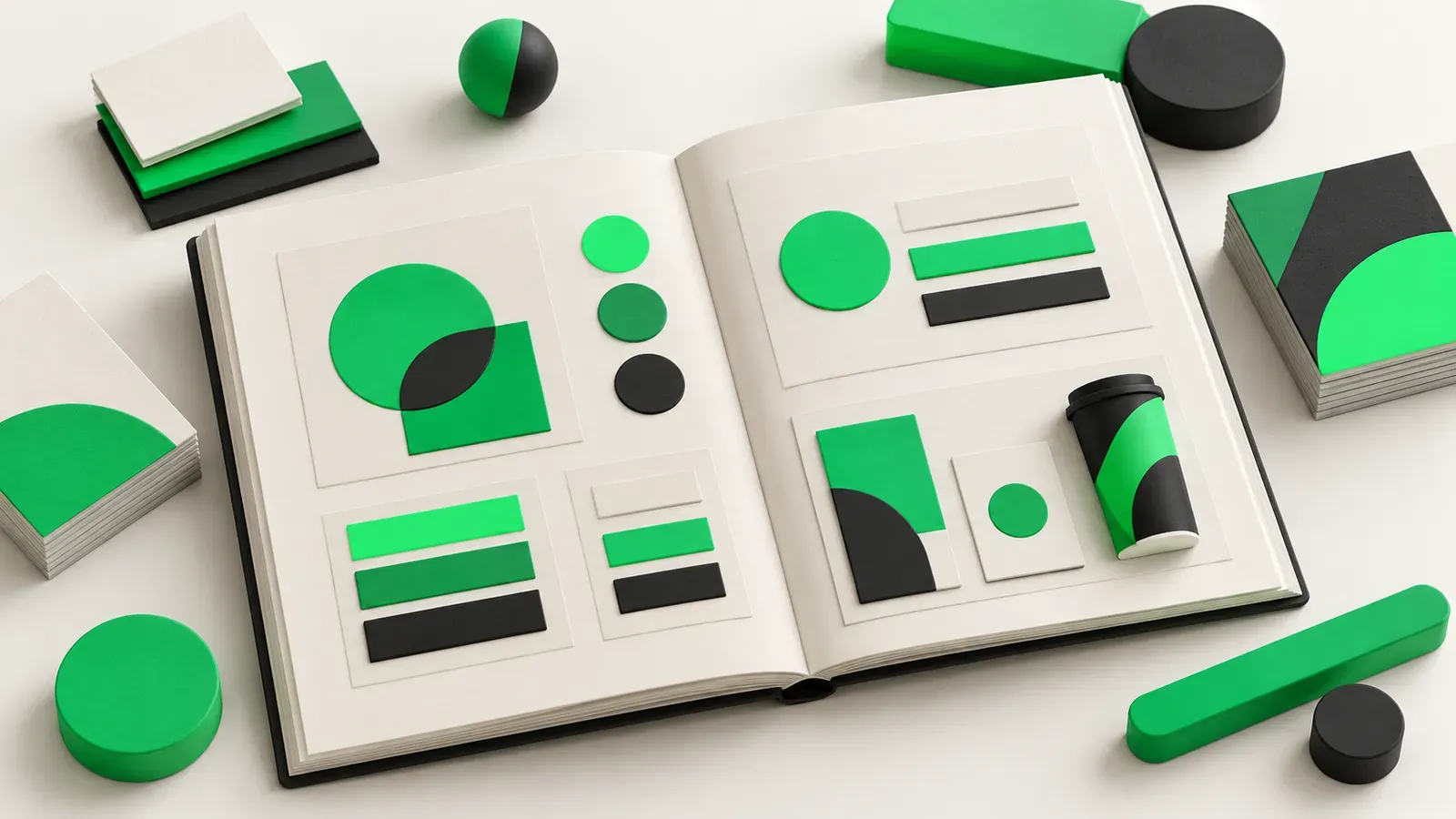
The strongest handbooks connect rules to decisions. Instead of saying “use the logo correctly,” a page can show clear space, unsuitable backgrounds and examples of incorrect stretching. Instead of saying “sound confident,” a voice section can show a customer email, a blog introduction and a sentence that the brand would not publish.
A handbook fits a business with employees, contractors or several customer touchpoints because contributors will face questions that a one-page sheet cannot answer. It takes substantially more planning and maintenance: someone must decide which rules matter, collect current examples and remove guidance that no longer reflects the business.
Mistakes that make handbooks less useful
- Document every possible brand decision.ExpectationThe team will have an answer for every situation.Mechanical realityContributors may stop searching when the guide becomes unwieldy.Length hides the rule needed for the task at hand.Works when Detailed sections are indexed and linked to real applications.
- Describe the voice with adjectives only.ExpectationEveryone will interpret “warm” or “bold” consistently.Mechanical realityDifferent writers produce noticeably different sentences.Adjectives do not show word choice, rhythm or boundaries.Works when Each description has examples and counterexamples.
The handbook’s main weakness is not detail itself; it is detail that nobody can locate. Use headings that match real questions, such as “How do we write product claims?” or “Which logo file goes on a dark background?” A handbook should support a decision rather than become a record of every conversation the brand has had.
Create separate brand playbooks for each channel
Channel playbooks turn core brand rules into practical guidance for a website, blog, email, LinkedIn, Instagram or sales material. The central brand remains the same, but each playbook explains the format, pace, level of detail and interaction style that suit a particular channel.
A website playbook might cover page headings, calls to action, navigation labels and proof points. A blog playbook might cover article structure, search intent, internal linking and how much background a reader needs. A social playbook might show caption length, post types, replies and when an image needs text or context. Sales material may need a separate check for claims, supporting evidence and consistency with current offers; a reader auditing existing material can use this marketing collateral checklist.
Channel-specific guidance is worth the effort when one generic voice keeps being copied everywhere. A thoughtful LinkedIn post should not read like a website service page, and an email subject line has a different job from a long-form article introduction. The shared promise, positioning and terminology still belong in one central source of truth.

Separate playbooks can drift apart if different contributors update them independently. Give each channel guide an owner, link it back to the central rules and review it when the business changes its offer or audience. For practical social publishing guidance, see social media marketing.
Turn brand guidelines into a living content workflow
A living content workflow makes brand rules part of briefing, drafting, checking and approval instead of leaving them inside a static PDF. The workflow can check approved terminology, required messages, tone boundaries and basic content rules before a draft reaches the owner.
Questions to choose the right format
Answer these questions before deciding how much brand guidance to create.
- Does one person create nearly all content, or do employees and contractors contribute?
- Do you publish in one channel, or do website, email, social and sales materials need different treatment?
- Can a new contributor find the correct rule without asking the owner?
- Which mistakes would be expensive or embarrassing if they reached publication?
- Do you publish often enough for a brief and review process to save repeated explanation?
Where brand guidance enters the workflow
- Brief The brief records the audience, purpose, required message, prohibited claims and channel.
- Draft The writer uses approved terminology, tone examples and the channel’s practical rules.
- Checks Automated or manual checks flag facts, brand rules, policy, originality, SEO or machine-readability issues.
- Approval The owner reviews the draft, requests changes or approves it for publication.
For example, a weekly content plan might require the phrase “independent bookkeeping support” and prohibit an unsupported claim such as “the fastest service in town.” A draft that fails a brand-rule check can be held for review rather than moving straight to approval. The rule has become a gate in the process, not a sentence buried in a document.
Vibrant Media says its automatic quality checks run on every draft before the owner approves it, covering facts, brand rules, policy, originality against the project’s published archive, SEO and machine readability. Its chief manager turns a brief into a weekly content plan and assigns specialists, while the owner remains the approval point.
Checks to put beside every content brief
- Name the audience and the channel before drafting.
- List the one message the content must communicate.
- Record approved terms and any claims that need evidence.
- Add one example of the desired tone and one example to avoid.
- Hold drafts that fail a check until a person reviews the issue.
- Keep unusual, sensitive or high-stakes decisions with a human reviewer.
Brand guidelines examples: practical questions
Should a small business start with a handbook?
A small business can usually start with a one-page essentials sheet when one owner or a very small team creates most content. Add handbook sections when contributors repeatedly ask about logo use, visual choices, claims, tone or customer-facing applications. Starting smaller also makes it easier to discover which rules need documenting.
Can channel playbooks replace central brand guidelines?
Channel playbooks should extend central brand guidelines rather than replace them. The central guide holds the promise, positioning, audience, terminology and core voice. Each channel playbook then explains how those rules appear in a website, blog, email, social post or sales asset.
Can automated checks decide whether content is on-brand?
Automated checks can flag known terminology, required messages, prohibited patterns and other defined rules. They cannot settle every unusual, sensitive or context-dependent judgement. A practical workflow uses checks to catch repeatable problems and keeps final approval with a person.
Vibrant Media is a subscription AI marketing team that creates, publishes and measures content for businesses, offering ai marketing, content marketing and small business marketing. vibrantmedia.com